
Don’t Overoptimize. Automate.
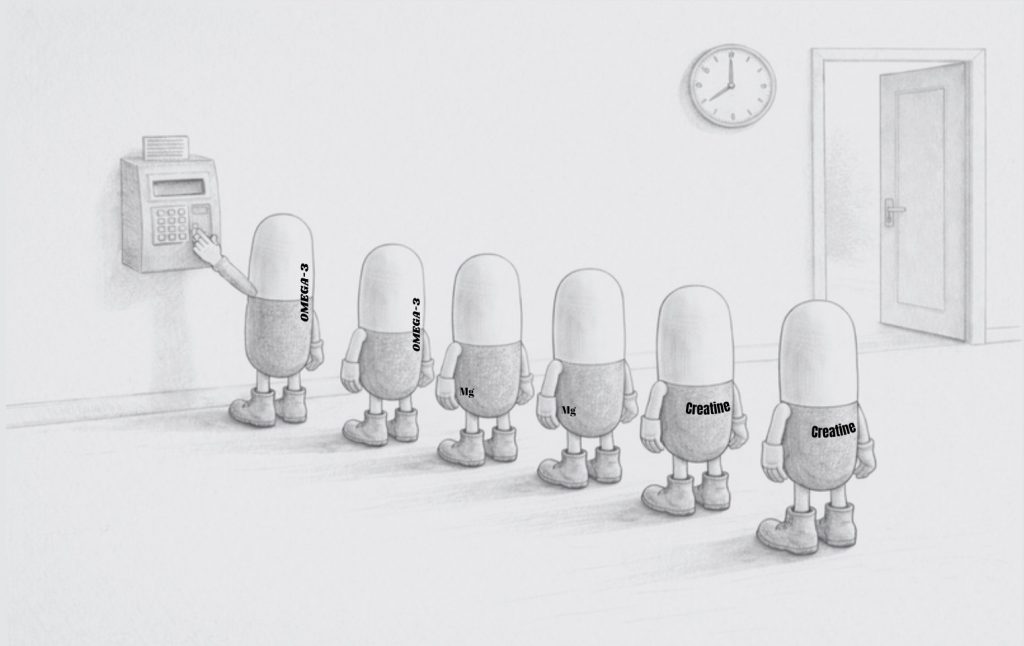
Why supplements fail not because of knowledge, but because of daily life.
Intro
For a long time, I believed the problem with supplements was the abundance of choices. Countless products, too much information, and even more opinions. Should I take fish oil? Should creatine be taken only on training days? Is magnesium better in the morning or in the evening? At some point, I realized that the problem was never the what – it was the when. My supplements were in the cupboard. Sometimes I took them, sometimes I didn’t. On stressful days, I forgot about them completely. On other days, I put them off until “later”, but later rarely came. It was only when I chose a fixed time that something changed – not spectacularly or radically, but sustainably. This is where the topic of a supplement routine begins.
What Science Says
From a nutritional standpoint, the situation is relatively clear: certain supplements – especially omega-3 fatty acids and creatine – can measurably improve health, performance, and recovery when taken in the right doses and on a regular basis. The key is consistent use over time, not perfect optimization. However, behavioral research shows a recurring pattern: health routines rarely fail due to a lack of knowledge, but because of a failure to integrate them into everyday life. A 2025 study sums it up: small, context-specific changes beat ambitious but fragile resolutions. Behavior becomes stable when it no longer requires active decision-making.
A study from 2010 already showed that habits are formed through repetition in the same context. The key factor here is the link between the trigger and the action. A 2024 meta-analysis confirmed this, finding that fixed times and stable contexts significantly accelerate habit formation, regardless of the behavior itself.
Two studies from 2012 and 2014 take this idea a step further, describing habits as mental shortcuts. The brain learns to respond automatically to a stimulus; conscious control is then no longer necessary. This is precisely why fixed routines are so powerful. And this is also why new routines that are supposed to take place “sometime during the day” tend to fail.
Small Change
In the context of your supplement routine, this means that as long as taking them requires an additional decision, the routine will remain fragile. It only becomes resilient when linked to an existing routine. The small change is therefore as effective as it is unspectacular: Choose a fixed time for your supplements and a specific context – both always the same. Then, place your supplements in a visible location where you plan to take them, such as beside the coffee machine or your toothbrush. For me, it has become a habit to take my supplements right after my morning shake. Everything that is good for me comes right at the start of the day, so to speak, to strengthen my armor for the challenges ahead.
Compounding Effect
What happens next is not a big “aha” moment, but rather a quiet process. The brain links stimulus and action. After a few weeks, taking your supplements will become automatic. This is where the compounding effect of your supplement routine comes into play, because it is only through regularity that you enable their long-term effects. Omega-3 doesn’t support your heart and brain through individual capsules; creatine doesn’t have a positive effect on your muscle growth and brain function when only taken sporadically. Their essential effects only arise through consistency over time.
Let’s try it!
James Clear puts it pragmatically in Atomic Habits: The best habit is one that doesn’t require motivation. B.J. Fogg comes to the same conclusion in Tiny Habits: Behavior becomes stable when it is small, simple, and clearly anchored.
It doesn’t require new insight, it only needs a fixed place in your everyday life. Make your supplement routine easy. Just pick a time and create a simple setup. It doesn’t have to be perfect or original to work. All it takes is simplicity and repetition. Don’t overoptimize. Automate it, and let consistency do the work.
In addition to your supplements, a glass of water and your first coffee can also give you a boost for the whole day. Learn here how a glass of water is more than just a fuel for the day ahead. Learn here how delaying your morning coffee can boost your energy, focus, and sleep.
For a deeper insight:
Lally et al. (2010). How are habits formed: Modelling habit formation in the real world.