
Have The Courage to Leave a Gap.
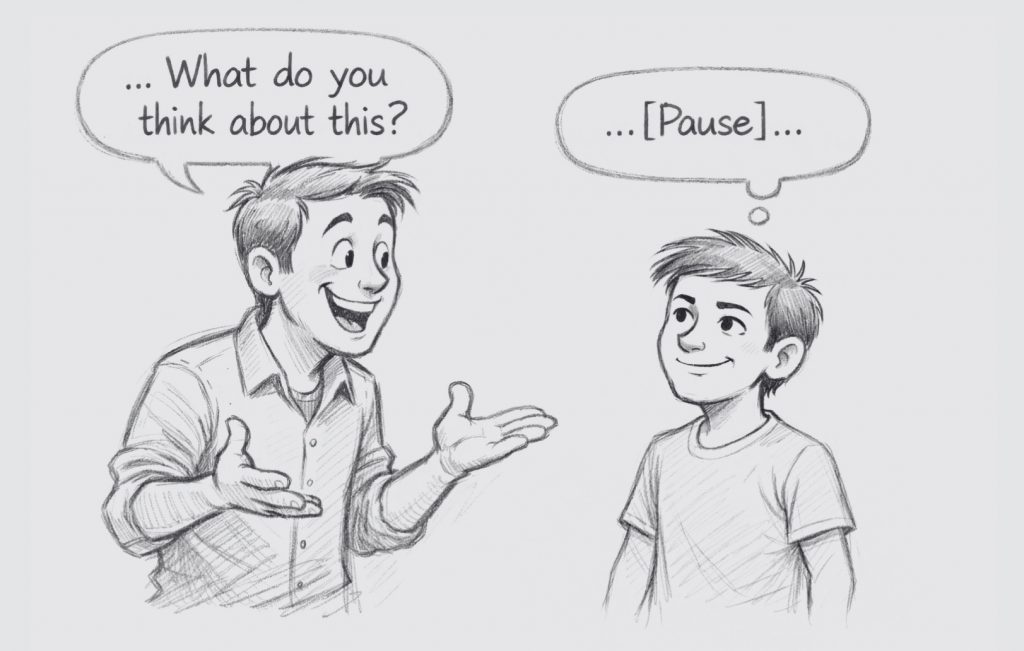
Why a pause has a clearer effect than any filler word.
Intro
I remember situations when I was in the middle of an important conversation and suddenly an “um” slipped out of my mouth. This usually happened when I was looking for the right word or phrase or trying to formulate my next thought, especially during formal conversations, presentations, or when asked unexpected questions. Over time, I noticed that the harder I tried to avoid saying “um”, the less successful I was. It was even more difficult to respond without a filler word under time pressure. Only when I stopped fighting the filler word and, instead, allowed myself to pause I noticed a change in my communication.
What Science Says
Science confirms my experience. Filler words, such as “um”, “uh”, and “What’s that called again?”, typically arise when thinking and speaking fall out of sync. Filler words serve as acoustic placeholders, buying time while the next thought is formed. Although they are normal in many conversations, they aren’t neutral signals for listeners. Since the 1990s, several studies have shown that listeners interpret filler words as a sign of uncertainty or lack of clarity. This is particularly true in scientific and formal presentations, where precision and clarity are essential.
Two additional studies from 2001 have shown that filler words disrupt the flow of speech and make understanding and processing information more difficult. Listeners can compensate these interruptions, but they must expend additional cognitive resources to do so. While this doesn’t make understanding impossible, it does make it less efficient.
In contrast, a 2023 study showed that pausing between sentences stabilizes the linguistic signal and improves processing information. Unlike an “um”, a pause can help listeners focus on the message. The decisive factor isn’t the length of the pause but its quality. The results of a 2025 study complement these findings. According to this study, listeners interpret deliberate pauses as a sign of focus and mental precision.
A pause signals control. Filler words signal searching.
Small Change
Short pauses are key to greater competence and clarity. The “small change” I would like to recommend is as follows: In a conversation, pause for 1–2 seconds before expressing your thoughts. Especially when you feel the urge to say “um” or “uh”, pause and remain silent. This moment of silence will give you time to organize your thoughts, lending your speech calmness and precision. Instead of trying to fight the “um”, replace it with a pause as a strategic tool to express more clearly and confidently.
Compounding Effect
When used regularly, this small intervention will change more than just individual sentences. The first results are quickly visible: You will use fewer filler words. Therefore, your speech will become clearer because you will make more conscious transitions. Hence, you will appear calmer, and thus more confident and competent. A significant side effect is that pausing will help you keep a clear head in stressful situations. Your listeners will thank you for it – and will really understand you.
Let’s try it!
Looking back on my past conversations, I realize that it wasn’t the “um” that was the problem, but my impatience in expressing my thoughts. However, small pauses don’t hold me back. They allow me to communicate my thoughts more precisely and build a better connection with the person I’m talking to.
Try it out. Not at the perfect moment, but at the next one. Use the pause as a tool. Have the courage to leave a gap.
During your conversations don’t forget that a simple smile can transform your interactions, and that calling people by their name can make a big difference. In addition, learn here why unclear statements lead to very clear misunderstandings and how to avoid it.
For a deeper insight:
Van Zant, A. B., et al. (2025). The power of pausing in collaborative conversations.
Fox Tree, J. E. (2001). Listeners’ Uses of Um and Uh in Speech Comprehension.
4 responses to “Have The Courage to Leave a Gap”
-
I am regular visitor, how are you everybody? This post posted at this web page is truly pleasant.
-
Thank you!
-
-
This is very interesting, You’re a very skilled blogger.
I’ve joined your feed and look forward to seeking more
of your excellent post. Also, I have shared your web site in my social networks!-
Thanks a lot!
-


Leave a Reply