
Say My Name, Say My Name!
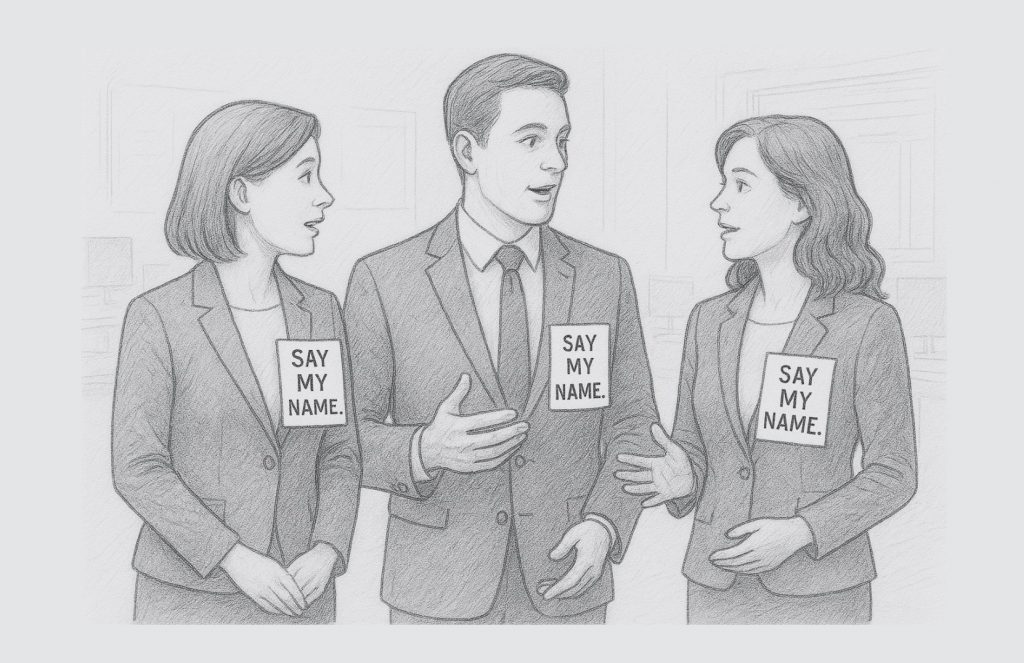
People hear hundreds of words every day, but they only really respond to one: their name.
Intro
Imagine being at a loud party full of people. There’s music, chatter, and clinking glasses. The sound of voices and movements overlap, merging into background noise. Suddenly, you hear a word: Your name. For a moment, everything is quiet. You lift your head, look around, and search. Who was talking about you?
What Science Says
This little phenomenon is no coincidence. Our brains are wired to respond to our own names, even when we seem not to be listening. As early as the 1950s, researchers discovered that we can hear the sound of our own names even when our attention is elsewhere. Later studies showed that hearing our own name activates regions of the brain associated with identity, self-reference, and social perception. No other word reaches this depth. Even when we are half asleep or mentally absent, our name remains an inner signal: “That’s me.“
The real magic happens when we turn this mechanism around and use it with others. Using someone’s name triggers the same response in them as it does in us: attention, resonance, and meaning. Recent studies have shown that people who are addressed by name perceive their counterpart as more attentive, empathetic, and trustworthy. They feel seen. Not for what they do or what role they have, but for who they are.
Small Change
In a loud, fast-paced, information-saturated world that is often anonymous, this can make all the difference. That’s why my small but effective recommendation is this: Call someone by their name when you greet or say goodbye to them.
Compounding Effect
It’s not just a rhetorical trick or a simple communication strategy; it’s a conscious form of mindfulness. This small addition has a greater impact than you might think. It makes you appear more present and attentive. At the same time, it makes the other person feel truly noticed. This habit can even create closeness where neutrality prevails and convey attention and respect where routine and sobriety prevail.
Let’s try it!
This demonstrates in a textbook way how big impacts can be achieved with small gestures. In fact, one of the strongest forms of recognition can lie in something as simple as the sound of one’s own name. Of all the words we hear every day, our own name is one that our brain never overlooks, and the one that activates our deepest social connection. Let’s call it. As Dale Carnegie wrote: “A person’s name is to that person the sweetest sound in any language.“
Before thinking about their name, try smiling. Learn here how a simple smile can change your communication and mood.
For a deeper insight:
Moray, N. (1959). Attention in Dichotic Listening: Affective Cues and the Influence of Instructions.
Carmody, D. P. & Lewis, M. (2006). Brain Activation When Hearing One’s Own and Others’ Names.
Bao, H. et al. (2023). Specificity in the Processing of a Subject’s Own Name.
Carnegie, D. (1936). How to Win Friends and Influence People. Part Two, Chapter 3.
Leave a Reply